
Why Hacksaw Gaming's Fishing Slot Is the Best Entry Point — and When It Isn't

Hacksaw Gaming has built something unusual with the Le series: a franchise. Not in the loose sense that most providers use the word — slapping a shared name on mechanically unrelated games — but a genuine, iterative design lineage where each new entry inherits the DNA of its predecessors and adds something structurally meaningful.
Le Fisherman, released in March 2026, is the fourth game in that lineage. It is also, by most objective measures, the most accessible. Whether that makes it the best depends entirely on what you're looking for. This guide breaks that down properly — not just the headline numbers, but the mechanical logic underneath them, the specific situations where Le Fisherman outperforms its siblings, and the situations where it doesn't.
Understanding the Le Series Architecture
Before comparing individual games, it's worth understanding what makes the Le series a series at all. Three structural elements run through every entry:
Golden Squares. Every Le series game is built around the Golden Squares mechanic. Winning positions on the grid become highlighted Golden Squares. When a Rainbow symbol lands, it activates those squares, revealing special symbols — Coins, Clovers, Buckets, or the more powerful Global Buckets. The specific implementations differ between games, but this core loop — accumulate squares, activate with Rainbow, collect specials — is the mechanical spine of the entire franchise.
Smokey the Raccoon. The protagonist wears different costumes across games (train robber in Le Bandit, Greek warrior in Le Zeus, pharaoh in Le Pharaon, fisherman in Le Fisherman), but the character serves the same narrative function: a mascot that signals belonging to the franchise and provides the vehicle for costume-based bonus differentiation.
The escalating bonus structure. Every Le series game features a tiered bonus system where more scatter symbols trigger more powerful bonus rounds. The architecture is consistent: a first-tier bonus (3 scatters) that introduces persistent Golden Squares, a second tier (4 scatters) with enhanced mechanics, and a hidden or ultra-rare tier (5 scatters or specific sequence) that represents the maximum win potential.
This shared architecture means that if you understand one Le series game deeply, you already have the foundation for understanding all of them. The differences are about calibration — volatility, max win ceiling, specific mechanical additions — not about fundamental design philosophy.
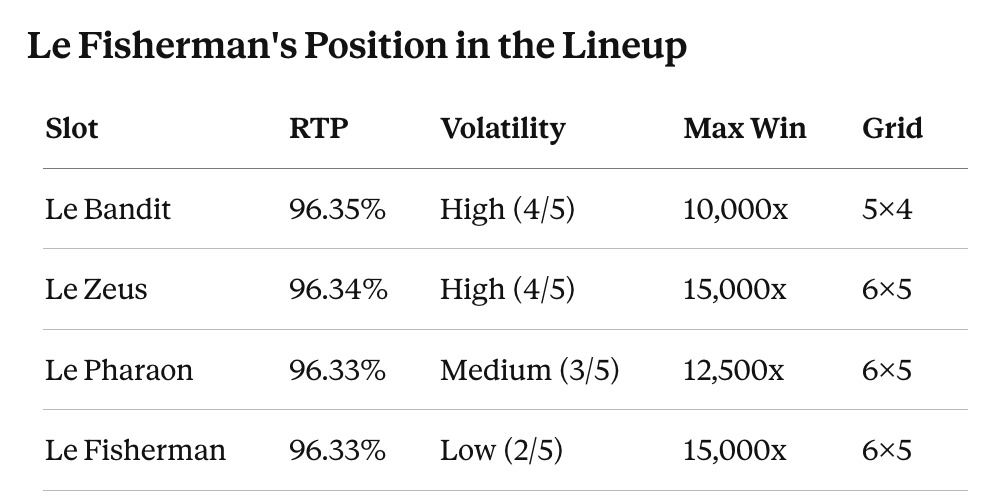
The trajectory is clear. Le Bandit launched the franchise with high volatility and a capped max win of 10,000x on a smaller grid. Le Zeus pushed the grid to 6×5, increased the max win ceiling to 15,000x, and maintained high volatility. Le Pharaon pulled volatility to medium. Le Fisherman completes the arc: the same 15,000x ceiling as Le Zeus, but on low volatility.
This is not a coincidence. Hacksaw Gaming is deliberately filling different segments of the player market. Le Bandit and Le Zeus are for players who want high-variance experiences — the possibility of large wins in fewer spins, with the corresponding risk of extended losing runs. Le Pharaon and Le Fisherman are for players who prioritise session longevity, consistency, and a more predictable experience within their allocated budget.
What Low Volatility Actually Means at the Mechanical Level
Low volatility is frequently misrepresented in casino content as simply "more frequent wins." That's partially true but misses the mechanical reality.
Le Fisherman's 42% hit frequency means that roughly 2 in every 5 spins produce some payout. For context, a typical high-volatility slot might have a hit frequency of 20–25%. This difference has a concrete effect on session dynamics: in Le Fisherman, you rarely spin through 10 consecutive non-paying spins. In Le Zeus or Le Bandit, that is a routine occurrence.
However — and this is the part often glossed over — the distribution of those wins is heavily skewed toward the lower end of the pay table. The 42% hit frequency includes a large proportion of wins that are 0.1x–0.5x your bet: they return a fraction of the spin cost and are, economically, very close to losses. What low volatility genuinely provides is a slower rate of bankroll erosion, not a guarantee of profitability.
The practical implication for UK players on a fixed session budget is meaningful: with a £50 bankroll at £0.50 stakes, Le Fisherman will typically deliver a longer session than Le Zeus at the same stakes. The expected number of spins before the bankroll is exhausted is higher because the bleed rate is lower. Whether that translates to more fun depends on the individual player.
Le Fisherman's Core Differentiator
The Big Catch Bar is Le Fisherman's most significant addition to the franchise formula. It doesn't exist in Le Bandit, wasn't fully developed in Le Zeus, and represents Hacksaw's most refined implementation of a progressive bonus escalation mechanic.
The Bar functions as a separate progression system within the bonus rounds, independent of the Golden Squares accumulation on the main grid. It fills when FS symbols land during free spins. Every five FS symbols advances the bar by one level. Each level advancement awards +5 free spins and upgrades the effect that Rainbows produce:
Level 1 — Rainbows become Green Clovers (x2–x20 multipliers applied to adjacent symbols).
Level 2 — Rainbows become Global Buckets (collect the entire grid's Coin value in a single action).
Level 3 — Rainbows become Gold Clovers (x2–x20 multipliers applied to all Coins on the grid simultaneously, not just adjacent ones).
Level 4 — Rainbow or Epic Rainbow guaranteed on every single spin.
The escalation from Level 1 to Level 4 is nonlinear in terms of value. Level 1 adds meaningful but modest wins. Level 2 introduces the first genuinely large single-spin potential through Global Bucket collection. Level 3 compounds that potential by multiplying the entire Coin grid. Level 4 makes the compound resolution guaranteed on every spin.
In the Smokey Under Water bonus — the hidden fifth-scatter trigger — the Big Catch Bar begins at Level 4 and cannot regress, because FS symbols cannot land in that bonus (meaning the Bar has no mechanism to advance or retrigger, but also no mechanism to drop). The result is 10 free spins with guaranteed Rainbow or Epic Rainbow resolution every spin, combined with Progressive Golden Squares from Slippery When Wet mechanics. This is the specific configuration where the 15,000x max win lives.
Feature Buy Analysis: Cost vs Expected Return
Le Fisherman's Feature Buy options deserve more analytical attention than the typical "here are your options" treatment provides. The five available buys (noting that UK-licensed casinos may restrict Feature Buy per UKGC regulations) operate at very different risk/return profiles:
BonusHunt (3x stake) — This doesn't buy a specific bonus. It increases bonus trigger probability for the spin. At 3x cost, it represents a modest expected-value trade: you're paying slightly more than three standard spins for an increased chance of entering some bonus tier. The key word is increased probability, not guaranteed trigger. For players wanting to extend natural play with more frequent bonus chances, this is the least disruptive Feature Buy.
Rainbow Trout (50x stake) — Guarantees at least one Rainbow in the next spin. This is a meaningful guarantee because Rainbow activation is the mechanism that converts accumulated Golden Squares into payouts. At 50x, it essentially guarantees a payout proportional to however many Golden Squares have accumulated. In a base game state with minimal Golden Squares, the return may not cover the 50x cost. After significant Golden Square accumulation, it can return multiples of the buy.
On Thin Ice Feature Buy (60x stake) — Buys direct entry into the first bonus tier. At 60x, you're paying for 10 free spins with persistent Golden Squares and Big Catch Bar access. Given the average expected returns of the On Thin Ice bonus (~50–200x), this buy has a positive expected return relative to standard play variance but is not guaranteed profitable on any individual trigger.
Slippery When Wet Feature Buy (250x stake) — Buys the second bonus tier directly. Progressive Golden Squares and 1x minimum Coin values substantially increase the average return. Expected returns of 200–800x make this a higher-ceiling option at proportionally higher cost. The key factor is whether Big Catch Bar advancement during the bonus reaches Level 2 or above, which dramatically changes the outcome distribution.
Epic Rainbow Drop (500x stake) — Buys a guaranteed Epic Rainbow activation. At maximum Golden Square accumulation, an Epic Rainbow can generate 1,000x+ in a single resolution. The expected value of this buy is theoretically positive at high Golden Square counts, but the variance is substantial: the return distribution is wide. This is appropriate only for players who have built significant Golden Square positions in the base game and want to guarantee their activation rather than waiting for a natural Rainbow.
The critical insight about Feature Buys in Le Fisherman — often missed in standard guides — is that their value is not static. A 500x Epic Rainbow Drop bought immediately on loading the game, before any Golden Squares have accumulated, is a very different bet from the same buy made after 30+ spins have built substantial Golden Square coverage. The mechanic rewards players who understand the current state of their grid, not just the cost of the buy.
Le Fisherman vs Le Zeus: The Direct Comparison That Matters Most
The comparison players are most likely to face in practice is between Le Fisherman and Le Zeus, since both sit on the same 6×5 grid, share the same 15,000x max win, and have nearly identical RTPs (96.33% vs 96.34%). The differences are more consequential than the headline numbers suggest.
Volatility gap. Le Zeus is High (4/5). Le Fisherman is Low (2/5). This is a substantial difference. Le Zeus has a much wider win distribution: more frequent near-zero sessions, occasional sessions that return 5x–20x the starting bankroll. Le Fisherman has a narrower distribution: fewer catastrophically short sessions, fewer breakout sessions.
Bonus route to max win. In Le Zeus, the big win potential runs through the Mystery Meter mechanic and the highest bonus tiers. In Le Fisherman, it runs specifically through Smokey Under Water — the hidden fifth-scatter bonus. This distinction matters because Smokey Under Water cannot be purchased through any Feature Buy, only triggered naturally. For players who rely on Feature Buys to access high-potential bonus states (a common strategy), Le Zeus provides a purchaseable path to the highest-tier action that Le Fisherman does not.
Session feel. Le Zeus's high volatility creates sessions that feel like distinct episodes: long stretches of base game play followed by an occasional bonus that may or may not be transformative. Le Fisherman's low volatility creates sessions that feel more continuous: the 42% hit frequency keeps the base game engaged, bonuses arrive more predictably, and the experience is less feast-or-famine.
The right choice depends on a single question: do you have a larger bankroll and a tolerance for high variance in exchange for the possibility of a session-defining win? Le Zeus. Or do you have a defined session budget and want to maximise the probability of a complete, engaged experience within it? Le Fisherman.
Cluster Pays Mechanics: Why Le Fisherman's Grid Design Is Better Than Most
Le Fisherman's 6×5 Cluster Pays grid deserves examination as a mechanic independent of the Le series context, because not all cluster pays implementations are equal.
The core cluster pays mechanic — wins from 5+ matching symbols connecting horizontally or vertically — creates a fundamentally different relationship between the player and the grid than traditional payline slots. In a payline slot, each spin's outcome is determined by the symbols on a fixed number of predefined paths. In a cluster pays slot, the entire grid is active space: symbols anywhere can form part of a win, and the spatial distribution of matching symbols matters.
Le Fisherman's Super Cascade mechanic adds a second layer. Unlike simple cascade systems (where winning symbols are removed and replaced), the Super Cascade removes all instances of the winning symbol type from the grid — not just the symbols that formed the cluster. If you win with a cluster of 8 Anchors, and there are 4 additional Anchor symbols scattered elsewhere on the grid not part of that cluster, all 12 Anchor symbols are removed. This creates a significantly more aggressive reshuffle than standard cascades, with a higher probability of triggering Golden Square accumulation on cascade positions.
Combined with the 42% base hit frequency, this means the base game generates Golden Squares at a healthy rate even without bonus rounds. Players who understand this will enter Feature Buys with pre-existing Golden Square coverage that meaningfully increases the buy's expected value.
Practical Session Guide for UK Players
The following is intended as practical guidance for actual play, not marketing copy.
Before your first real-money session: Play the free demo until you have personally experienced all three bonus tiers and the Big Catch Bar at each level. This is not optional. Le Fisherman's bonus mechanics interact in ways that require hands-on familiarity to evaluate in real time during a session. Understanding the difference between a Level 2 and Level 3 Big Catch Bar activation when deciding whether to retrigger or bank is material to your session outcomes.
Verify RTP at your specific casino. Le Fisherman has four RTP configurations: 96.33%, 94.33%, 92.34%, and 86.25%. The difference between the highest and lowest is not marginal — it represents a nearly 10-percentage-point increase in house edge. At 86.25% RTP, Le Fisherman returns £86.25 per £100 wagered (theoretically, over millions of spins). At 96.33%, it returns £96.33. Use casino game information pages or the in-game information button to verify before depositing. If the information is not clearly displayed, ask support.
Bankroll-to-stake calibration. A session budget of 150–200x your chosen bet size is the minimum for meaningful exposure to the bonus structure. At £0.50 stakes, that's £75–£100 as a session budget. This isn't a strategy for winning — it's a minimum for experiencing the game as designed, which includes entering at least 2–3 bonus rounds on a typical session. Shorter bankrolls may not reach a bonus round, resulting in a pure base-game experience that doesn't represent the slot's full design.
Feature Buy decision framework. The decision to use a Feature Buy should be made based on the current state of the grid, not the time elapsed or the mood of the session. Before any Feature Buy, count the active Golden Squares. If the grid has minimal Golden Square coverage, the Rainbow Trout and Epic Rainbow Drop buys will underperform their theoretical values significantly. If the grid has extensive Golden Square coverage after a long base game run, those buys may represent above-average expected value.
On Feature Buy restrictions in the UK. UKGC-licensed operators may restrict Feature Buy options for UK-resident players under responsible gambling guidelines. If you're playing at a UK-licensed casino and Feature Buys are unavailable, this is regulatory rather than operator-specific. The game remains fully playable without Feature Buys — the bonus rounds trigger naturally, and Smokey Under Water (the hidden bonus) cannot be purchased regardless of licensing jurisdiction.
The Verdict
Le Fisherman earns its place as the recommended Le series entry point for three specific types of players.
The franchise newcomer. If you've never played a Le series game, Le Fisherman's lower volatility means your first experience will involve more mechanical interaction with the Golden Squares system, more frequent bonus visits, and less likelihood of a session that ends before you understand what you're playing. The learning curve is the same across all Le titles; Le Fisherman's hit frequency gives you more spins — and more teaching moments — per unit of bankroll.
The session-budget player. If you arrive at a casino with a defined, non-negotiable session budget and want the highest probability of a complete, engaging experience within it, Le Fisherman's low volatility is structurally better suited to that goal than Le Bandit or Le Zeus.
The Smokey Under Water hunter. Paradoxically, the hidden fifth-scatter bonus that delivers the 15,000x maximum win is most accessible in Le Fisherman by virtue of the game's 42% hit frequency generating more spins per unit of bankroll — and therefore more natural opportunities for rare scatter combinations to occur. The probability per individual spin is identical across sessions, but more spins means more attempts.
It is not the right choice for players who prefer high-variance experiences with a narrower, more intense win distribution, or for players who rely on Feature Buys to access high-tier bonuses (since Smokey Under Water remains uncovered by any buy). For those players, Le Zeus is the appropriate recommendation.
The Le series is strong precisely because it contains both.